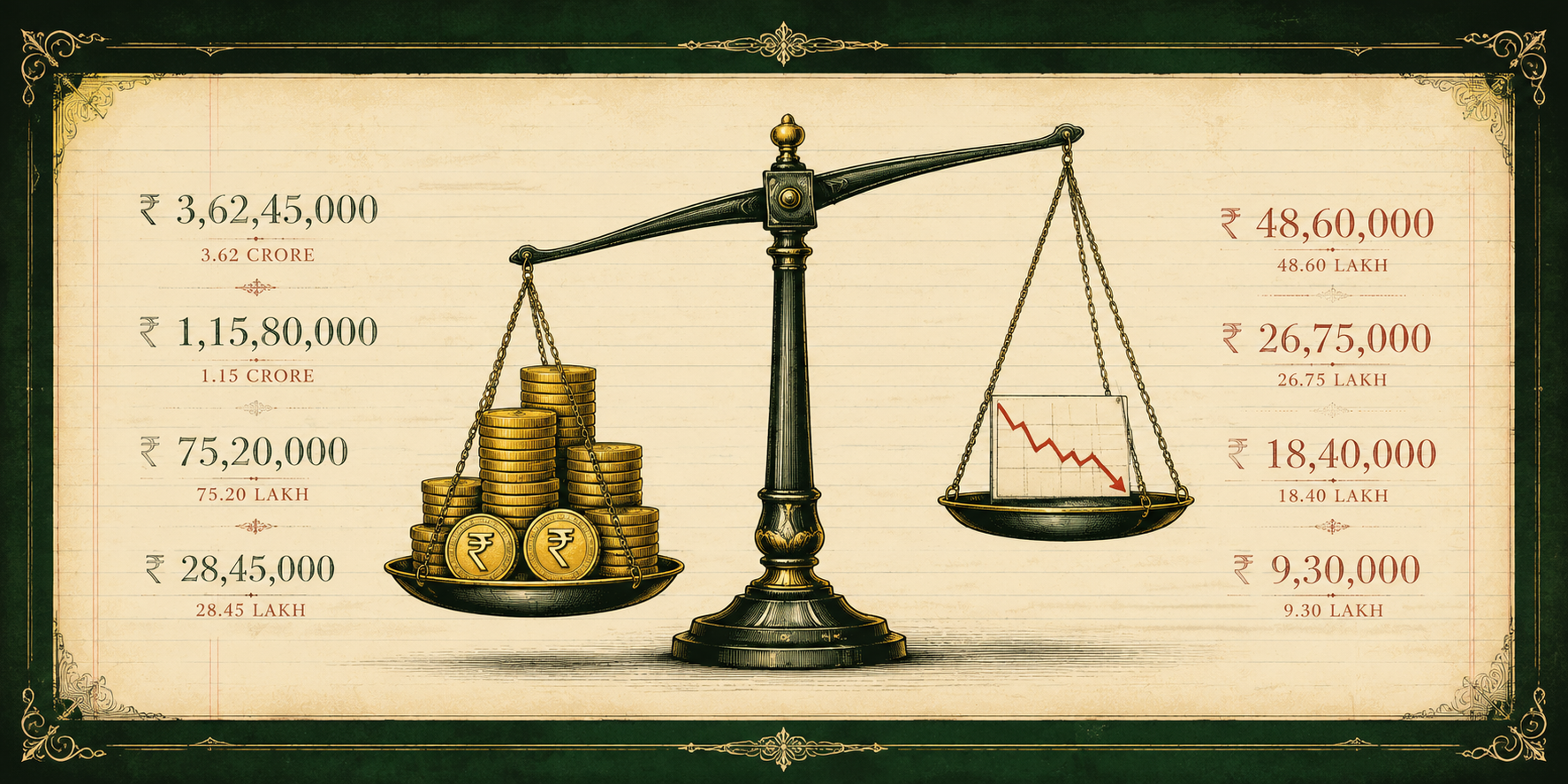
If you've been trading futures and options for a while, you already know the feeling. One good week convinces you that you've "figured it out." Then three bad weeks convince you that you're one trade away from winning it all back. That second feeling is the one that empties provident funds, breaks mutual fund SIPs, and turns friendships into awkward WhatsApp reminders about a loan that hasn't been repaid.
This isn't a story about willpower. It's a story about how the system is actually built — and the numbers, straight from India's own market regulator, are worth sitting with before your next trade.
What SEBI's own data says
The Securities and Exchange Board of India has studied this exact question three times in three years, and the answer hasn't moved much.
It gets worse in the most recent data. SEBI's July 2025 update showed individual traders' net losses widened by 41% in FY25 alone, crossing ₹1,05,000 crore in a single year, even as the total number of people trading actually fell. Fewer people are trading — and the ones still in it are losing more per person, not less.
And this isn't a small, careless minority. The same research found that among traders under 30, the group growing fastest as a share of the market, roughly 9 in 10 also lost money. Being young, online, and confident about "reading the charts" doesn't change the odds.
Where the money actually goes
This is the part that rarely gets explained in the reels that got you into trading in the first place. F&O trading isn't a closed game between you and "the market." It's a chain of parties, and most of them earn a fixed cut regardless of what happens to your position.
- The exchange earns a transaction charge on every contract that changes hands — whether that contract made you money or wiped you out.
- Your broker earns brokerage and other charges per order, per lot, per leg. More trades, more revenue for them, regardless of your result.
- The government collects Securities Transaction Tax, stamp duty, and GST on the transaction itself — again, independent of your outcome.
- On the other side of most winning trades sit proprietary trading firms and large institutions running algorithms — SEBI's research found that 96–97% of the profits earned by these professional players came from algorithmic strategies most individual traders have no access to.
Follow the money: what the companies actually made, in crores
Numbers make this real faster than any explanation can. Zerodha, Groww, and Angel One are the companies — the actual brokers you open an app and place a trade through. Here's what each reported as net profit — not revenue, actual profit after every expense — for the financial year ending March 2026 (FY26), the most recent full year on record.
How each of these companies actually built that number
Zerodha built India's largest brokerage without spending on ads for years — its revenue comes almost entirely from brokerage on F&O trades (equity delivery is free, but options and futures aren't) plus fees on other services. Being privately held, Zerodha discloses its annual numbers later than listed rivals — its most recent published figure is FY25's ₹4,237 crore, itself a 23% fall from the year before. Founder Nithin Kamath has since said brokerage revenue dropped roughly 40% in the first quarter of FY26 alone, which points to FY26's full number likely being lower still once it's disclosed.
Groww went the opposite direction — FY26 profit crossed ₹2,083 crore, up 14% on the year before, on the back of continued user growth (it's now India's largest broker by active users) after its November 2025 stock market listing. More users trading, more transactions, more fee income.
Angel One, one of the older listed brokers and a direct competitor to Zerodha and Groww, saw FY26 profit fall to roughly ₹915 crore as tighter F&O rules and slower trading activity weighed on the business through most of the year — though its final quarter alone saw profit more than double year-on-year as activity picked back up.
That's really the whole story in one line. A brokerage has zero financial interest in whether your specific position goes green or red. Their business model is built entirely on volume — the number of orders placed, not the direction they moved. The more actively you trade, win or lose, the better it is for the company on the other end of your app.
The two stock exchanges behind every trade
Behind every broker sits the actual marketplace where your order gets matched — the National Stock Exchange (NSE) and the Bombay Stock Exchange (BSE). These are stock exchanges, not brokers — you don't have an account with them directly, but every single order Zerodha, Groww, or Angel One places on your behalf runs through one of these two, and each one earns a small transaction charge on it regardless of who wins the trade.
In FY26, the National Stock Exchange reported a net profit of ₹10,302 crore — down 15% from FY25's ₹12,188 crore as market activity cooled — while the Bombay Stock Exchange nearly doubled its own annual profit to ₹2,487 crore, its best year yet, largely on the back of growing derivatives volumes. Neither of them needs you to win either; they earn on the transaction, not the outcome.
None of this requires anyone to cheat you. The structure itself guarantees that a large, fee-collecting machine — brokers and exchanges both — sits between you and every trade, and that machine gets paid first, before you find out if you won or lost.
Why "one more trade" is the trap
The pattern shows up the same way almost every time: a small early win, a growing sense of skill, a loss that feels like bad luck rather than bad odds, and then a series of bigger trades meant to "recover" the loss rather than build on a strategy. SEBI's data on repeat behaviour backs this up directly — more than three out of four people who lost money kept trading in the following period. That's not a market failure. That's the exact psychology gambling is built on: intermittent reward, near-misses that feel like almost-wins, and a sunk cost that keeps growing.
Paid "mentorship" and signal groups often sit downstream of this same psychology. A course fee or subscription is a fixed, guaranteed income for the person selling it — regardless of whether the strategy taught inside it makes you money. That's worth remembering before the next "proven strategy" pitch lands in your inbox.
If you're already in it — what to actually do
-
1
Stop trading before you plan anything else Not "trade smaller" — stop. Every additional trade is another shot at the same odds that got you here.
-
2
Write down the actual damage in one place Loan amount, PF withdrawn, SIPs broken, money owed to people. You can't rebuild a plan around a number you're avoiding looking at.
-
3
Deal with high-cost debt first A personal loan or borrowed money from a friend usually costs more, in money and in relationships, than any recovery trade could realistically earn back.
-
4
Rebuild PF and SIPs on a fixed monthly amount Even a small, automatic, boring contribution restarts compounding — the only reliable "strategy" retail investors consistently benefit from.
-
5
Talk to someone before the next dip in the account A family member, a fee-only financial advisor, or a debt counsellor. Isolation is what let the losses compound quietly in the first place.
F&O contracts exist for a real purpose — hedging real, underlying exposure for businesses and large investors. That's genuinely different from using them as a way to turn a salary into a jackpot. Nothing about the structure of the market is designed to make that second use case work out for you, and the data above is SEBI's own way of saying so as plainly as a regulator can.
If any of this hit close to home
Two free SalaryBit tools are built for exactly the situations this article talks about — no judgment, no login, just a clear next step.