
Almost every homemaker in India has gold. Almost none have insurance. This is Meena's story — and the honest, numbers-on-the-table guide every family needs to read alongside it.
Meena was forty-one when she finally said it out loud.
They were folding laundry, the TV murmuring in the background — some insurance ad, a man in a suit promising "₹1 crore, just ₹19 a day."
"What about me?" she said, not looking up. "What happens to the kids if something happens to me?"
Raghu laughed. Not to hurt her — just reflex, the way you laugh at a question that's never crossed your mind. "Why would you need insurance? You don't earn."
That was her birthday week. He'd gotten her two gold coins that year, like every year. Safe. Something you can hold. Something that looks like security. She put them in the locker, next to three others from birthdays past. Five coins now. Untouched.

"Why do you even need this?"
A few days later, over dinner, Raghu brought it up himself — half-joking, half genuinely confused.
"Okay, tell me. If something happens to you, what income are we replacing? I'm the one earning. If I die, you and the kids lose the salary — that's what insurance is for. If you're not earning anything, what exactly are we insuring?"
This is the exact question every homemaker eventually runs into — from a husband, a bank RM, an agent, or her own family. So let's actually answer it, the way a financial advisor would.
"But I'm the one paying the premium. Isn't that a waste?"
"Fine, I accept the logic. But I'm the one paying the premium every year. I'm already insured — isn't this just extra money going out for nothing? If I die, you need my income to survive. If you die, what am I losing, financially?"
Here's the honest answer: you're not just protecting against lost income. You're protecting against a lost person whose absence creates new costs. You already insure things that don't "earn" anything — a house, a car — because losing them creates a cost you can't absorb overnight. A homemaker's role is no different, except the cost of losing her is far higher, and far harder to absorb emotionally while also absorbing it financially.

"He's the earner — if she dies, what income did she even bring?"
This is the line that stings the most, and it's usually said without any real malice — it's just the default assumption nobody questions.
Sit with what that question actually implies: that a life only has financial value if it's on payroll. That eighteen years of raising two children, running a home, being present for every ordinary emergency — 2am fevers, school pickups, homework, meals — counts for nothing because no company issued a Form 16 for it.
But ask what happens practically, not sentimentally, the day she's gone. Someone has to be paid — a full-time helper, a nanny, a cook, after-school care — for years, while the surviving spouse manages a job and a household and grief, alone. That is a real, calculable, ongoing cost. It's just one that's currently being paid invisibly, in full, by her — for free.
Back to Meena
She thought about all of this on her own first. Then she brought Raghu into it — not to convince him, but to actually get it done, since she needed his income proof to apply.
He came along. Sat through the process with her. And somewhere in that conversation with the agent — hearing the numbers laid out plainly, hearing what a critical illness rider would actually cover — something shifted in him. He'd only ever pictured insurance as protection for when he wasn't around. He'd never once priced out what happens to their kids, their mornings, their home, if she wasn't.
Ten days later, the policy came through. ₹75 lakh. Her name on it, as the life insured, for the first time in eighteen years of marriage.
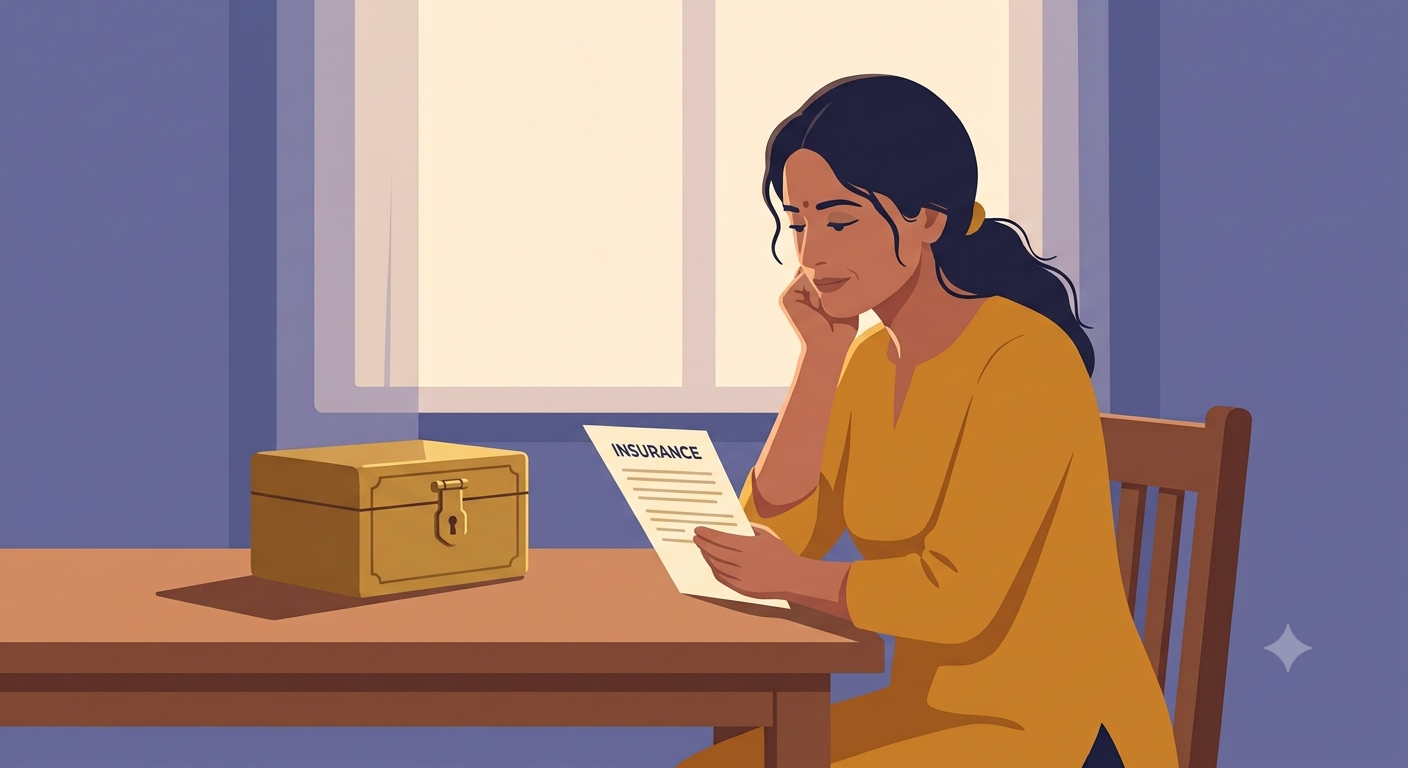
That evening she sat with the papers next to the locker of gold coins. Five coins. Eighteen years of birthdays. Safe, tangible, worth something — but not one of them was ever going to raise her children if she wasn't there to.
The paper in her hand did something the gold never could. It didn't sit quietly and shine. It put a number on what her absence would actually cost — and finally admitted what everyone around her had missed for eighteen years: she was never the backup plan. She was the whole plan.
How a homemaker actually buys term insurance in India
- Understand how your sum assured is calculated. Since you don't have personal income, insurers base your eligible cover on your spouse's income — typically 50–100% of his annual income, or a flat contribution-replacement estimate (commonly ₹25–50 lakh, sometimes higher). Cover up to ₹1 crore or more is possible depending on the insurer.
- Your spouse applies as the proposer. He doesn't need to be the life insured — you are. But since the sum assured is linked to his income, he provides income documents and pays the premium (and gets the Section 80C deduction on it).
- Gather documents: your ID and address proof, spouse's income proof (salary slips/ITR/Form 16), a routine medical check-up, and marriage certificate if required.
- Decision timeline: most insurers process the application, medical results, and income documents within 5–10 working days.
- Add a critical illness rider. If diagnosed with a serious illness, the family faces two costs at once — treatment, and replacing her role at home. The rider is usually inexpensive to add and covers exactly this gap.
- Compare 3–4 insurers — don't accept the first quote. Compare claim settlement ratios, not just premium price.
- Name your nominees clearly — usually the spouse or children — to avoid delay when the family needs the payout most.
| Factor | What it means for a homemaker |
|---|---|
| Sum assured basis | Spouse's income, not hers |
| Typical cover range | ₹25 lakh – ₹1 crore+ |
| Premium (41 yrs, ₹75L, till 60) | ~₹18,000–25,000/year |
| Tax benefit | 80C for premium payer; payout tax-free under 10(10D) |
| Processing time | 5–10 working days |