The Man Who Stopped Opening His Own Front Door

- Why He Stopped Opening the Door
- Layer One: The Home Loan That Felt Safe
- Layer Two: The Wedding Nobody Could Say No To
- Layer Three: His Father's Heart
- Layer Four: The Layoff
- Layer Five: The Trap That Looks Like a Lifeline
- The Number Nobody Could Untangle
- Three Tracks, Not One Fix
- What He Needed Wasn't Willpower
1Why He Stopped Opening the Door
Vikram used to leave for his morning walk at 6 AM sharp. Now he waits until his neighbours have left for work, checks the peephole twice, and still flinches every time the doorbell rings.
He's not hiding from the police. He's hiding from a number saved in his phone as "Do Not Answer 3" — a recovery agent from an instant-loan app who calls eleven times a day, and once stood outside his building for two hours.
To understand how a 34-year-old software engineer with a decent job ended up afraid of his own doorbell, you have to go back four years — because this isn't a story about one bad loan. It's a story about five ordinary decisions, none of them reckless on their own, that quietly stacked into a wall too tall to see over.
2Layer One: The Home Loan That Felt Safe

It started the way it starts for millions of Indians — a ₹45,00,000 home loan, EMI of ₹38,000, comfortably 30% of his salary. Every calculator, every bank RM, every well-meaning uncle said the same thing: this is the "good debt." Buy the house.
3Layer Two: The Wedding Nobody Could Say No To

Two years in, his younger sister got engaged. In many Indian households, "we'll manage" isn't a financial plan — it's an obligation. A ₹9,00,000 personal loan at 16% covered the venue, the jewellery contribution, the thousand small expenses nobody budgets for because refusing to pay felt like refusing to love her.
EMI: ₹19,500. Total monthly commitment now: ₹57,500. Still survivable — barely.
4Layer Three: His Father's Heart

Eight months later, his father collapsed at home. Angioplasty, ICU days, follow-up medication — ₹6,80,000, most of it not covered by the company's health policy because his parents weren't listed as dependents on his corporate insurance. Nobody plans for this line item. Nobody has ₹6,80,000 sitting liquid.
He didn't have time to compare interest rates in an ICU waiting room. He took whatever loan approved fastest — a formal NBFC personal loan, sanctioned in 4 hours, at 22%. EMI: ₹17,200.
Monthly commitment: ₹74,700.
Most corporate health policies don't auto-cover parents — they have to be explicitly added, often at extra premium. It's one of the most common, most expensive blind spots in salaried India, and it usually gets discovered in an ICU waiting room instead of during onboarding.
5Layer Four: The Layoff

Six months after his father was discharged, Vikram's entire team was "restructured" in a single all-hands call. Severance covered two months. It took him five to find another job — and the new offer came in 22% lower than his old CTC, because the market had shifted and he was negotiating from a position of fear, not strength.
His income dropped. His EMIs did not.
6Layer Five: The Trap That Looks Like a Lifeline

This is where most debt stories in India take their darkest turn — not with the big formal loans, but with what fills the gap between them.
Unable to make that month's home loan EMI, Vikram downloaded an instant-loan app. Approval in nine minutes, no paperwork, ₹50,000 in his account before dinner. It felt like rescue.
It was a 3% monthly processing structure disguised in fine print he didn't read carefully — an effective annual rate north of 40%, on top of an unusually short repayment window. He missed it by six days. That's when the calls started. Then the WhatsApp messages with his photo edited onto a "wanted" template, sent to five contacts from his phone — a manipulation tactic that is explicitly illegal in India, though that knowledge doesn't stop the fear at 11 PM.
7The Number Nobody Could Untangle
Here's Vikram's full picture today, and it's worth seeing exactly why it feels unsolvable:
| Debt | Outstanding | Rate | Monthly EMI |
|---|---|---|---|
| Home Loan | ₹41,00,000 | 8.5% | ₹38,000 |
| Sister's Wedding Loan | ₹6,50,000 | 16% | ₹19,500 |
| Father's Medical Loan | ₹5,10,000 | 22% | ₹17,200 |
| Two Credit Cards (min. due only) | ₹2,80,000 | 38–42% | ₹9,800 |
| Instant Loan App (defaulted, penalty accruing) | ₹68,000 | 40%+ effective | Harassment, not a number |
He is short by over ₹16,000 a month before he's even bought groceries. This is precisely the kind of situation where even a trained financial advisor pauses — because there's no single lever to pull. The home loan is "good debt" you don't want to touch. The medical loan is non-negotiable guilt. The wedding loan is family. The credit cards are compounding daily. And the loan app isn't really a financial problem anymore — it's a harassment problem wearing a financial mask.
8Three Tracks, Not One Fix

Generic advice fails Vikram completely. "Just make a budget" doesn't touch a ₹16,000 shortfall when there's barely discretionary spending left to cut. "Consolidate your loans" sounds clean until the home loan and the instant-loan-app debt can't legally sit in the same product. "Just talk to the bank" helps with the home loan and the NBFC loan — but does nothing for an unregistered app ignoring RBI rules altogether.
His situation needed to split into three parallel tracks, not one unified fix:
- Separate the legal debt from the illegal harassment. The home loan, wedding loan, and medical loan are real debts that deserve a real repayment plan. The loan app's threats — contacting his contacts, edited photos, repeated harassment calls — violate RBI's digital lending guidelines and IT Act provisions. A complaint to the RBI's Sachet portal and the local cyber cell moves that thread out of "debt" and into "crime being handled separately."
- Triage the real debts by what's actually bleeding him. Highest interest first, home loan protected since it's both the cheapest debt and the family's shelter.
- Rebuild the income side, not just the expense side. A ₹16,000 shortfall usually isn't closeable through cuts alone — it needs a side income stream, a formal EMI restructuring conversation with the home loan bank given the layoff, or both, run in parallel with the debt triage.
Treating a harassment problem and a repayment problem as one undifferentiated wave of dread is what makes a person stop opening their front door. Separating them — on paper, not just in your head — is often the single biggest relief in a situation like this.
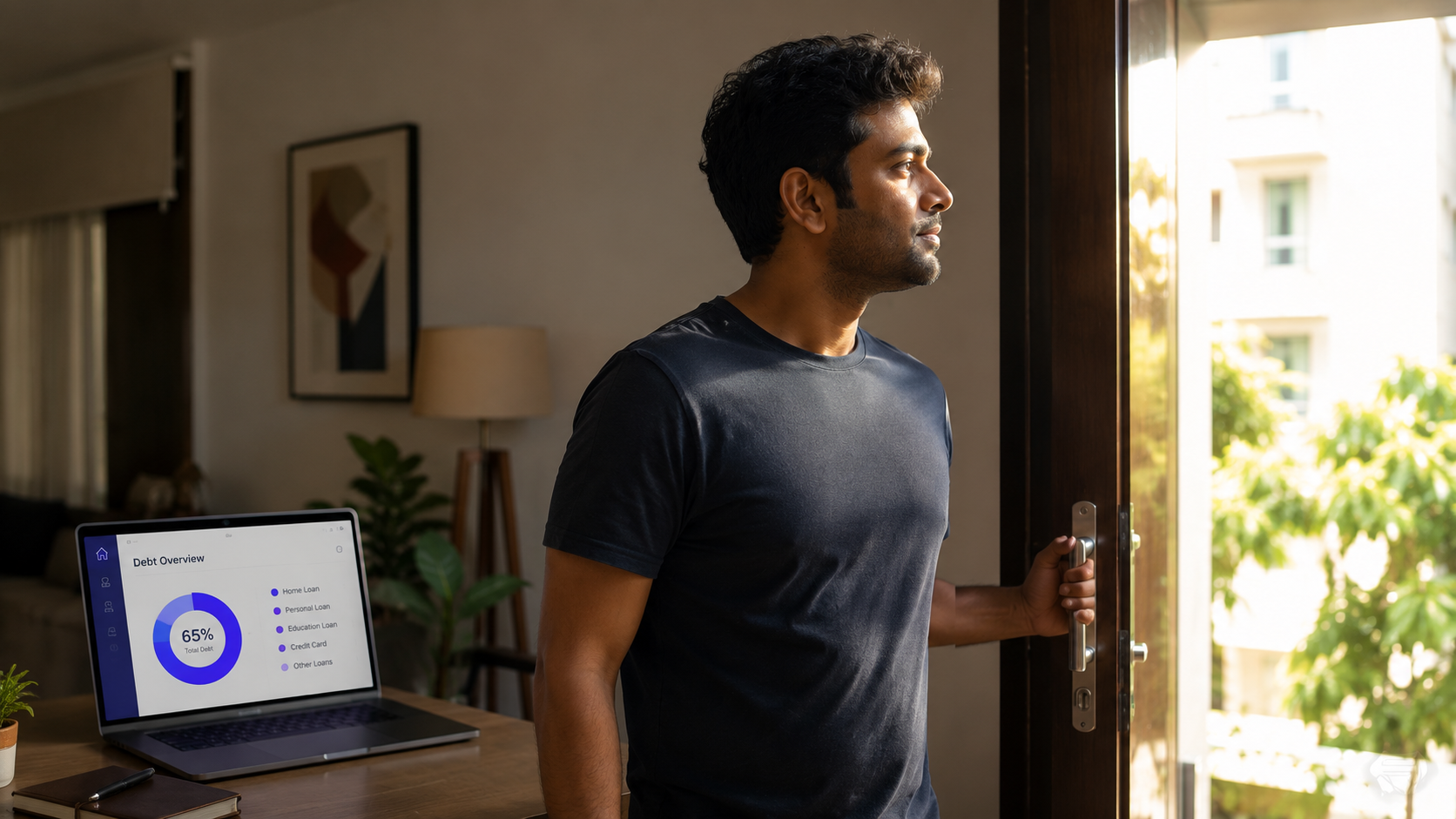
Get the Full Picture in One Place
Every loan and card, sorted honestly by what's actually costing you the most — home loan, personal loans, credit cards, all of it, in one clear debt passbook.
Fix Your Finance →Other SalaryBit Tools That Fit This Exact Situation
9What He Needed Wasn't Willpower
Vikram didn't lack discipline. He made five decisions — a house, a sister's wedding, a father's life, a job market that turned on him, and a moment of panic that led to the wrong app — and each one, alone, was defensible. Nobody warns you that defensible decisions can still stack into something crushing.
What he needed, months before the doorbell started terrifying him, was one honest, complete picture of every debt in one place — with the noise of shame and panic stripped out of it, and a clear line drawn between what's a repayment plan and what's a crime being committed against him.
If your finances feel this tangled — legitimate loans, family obligations, and something that might not even be a legal debt at all — the first move isn't another loan or another app. It's getting the full picture in one place, sorted honestly by what's actually costing you the most.